Casino Apps That Pay Real Money: The Identity Check Behind the Promise
 Available in GB
Casino apps that pay real money do exist, but the important question is not whether an app displays a cash balance. It is whether the operator can verify the account, explain its checks and pay out under rules that can be enforced. In Great Britain, that means a Gambling Commission licence; an offshore licence is not a substitute.

On 12 November 2026, the useful distinction is between a polished app and a properly accountable operator. The Gambling Commission says identity and age must be verified before a customer is allowed to gamble. It also says a withdrawal request must not be used to demand information that could reasonably have been requested earlier. Necessary anti-money-laundering checks can still cause delay. That is the sensible balance: check early, explain what is needed, and do not turn the cashier into a surprise obstacle course.
The scale is not trivial. The Commission estimates the remote casino sector generated £5.0 billion in gross gambling yield between April 2024 and March 2025. Yet a large market does not make every app safe, and a quick animation is no proof that a withdrawal will be quick. I look first at the identity process, then at who stands behind it.
What the numbers say about casino apps that pay real money
The strongest benchmark is not an app-store rating or a promotional claim. It is the Gambling Commission’s own account of identity checks and withdrawals. In its data for June to September 2024, covering 44.2 million withdrawals by customers of large online operators, 96.3% cleared automatically, 3.5% cleared within 24 hours and 0.1% took up to 48 hours.
Those figures describe large operators under British regulation, not every casino app and certainly not offshore sites. They are a useful comparison, not a promise. The Commission does not set a fixed maximum number of days for withdrawals. It does say there is no valid reason to delay a payout where there are no regulatory concerns, and operators should explain why a withdrawal is delayed or refused, subject to restrictions in money-laundering cases.
Here is the point that gets lost in the advertising: a payout is a process, not a button. The operator may need to check identity, payment ownership or the source of funds. But if the business could reasonably have checked identity earlier, demanding it only at withdrawal is precisely the kind of friction the Commission has warned against. A cheerful “instant cash” badge cannot improve on the paperwork.
Online casino apps that pay real money and the British benchmark
For online casino apps that pay real money, the British benchmark is a licensed remote casino. The operator must verify identity before gambling and must explain what documents may be needed before a deposit. If electronic checks are enough, verification may be instant; if documents are requested, the Commission says the process can take longer and gives no universal timescale.
The standards matter beyond speed. British licensees must participate in GamStop, the national online self-exclusion scheme. A GamStop exclusion covers online gambling companies licensed in Great Britain for the chosen term; it cannot be cancelled during that term, and it remains in place afterwards until the person contacts GamStop to remove it. Offshore sites are not licensed in Great Britain, UK protections do not apply there, and an offshore app is not a legitimate route around self-exclusion.
GamStop is often typed “gamestop”. The spelling is the least important detail. The boundary is not. The Commission says commercial gambling services offered to consumers in Great Britain require its licence, even where an operator holds a licence elsewhere.
For support, GamCare operates the National Gambling Helpline free on 0808 8020 133, 24 hours a day, every day of the year. It is also available by live chat and WhatsApp. BeGambleAware directs people to the same helpline; the NHS and Gamblers Anonymous also provide support services.
Why the Licence Matters for Your Casino App
A casino app that pays real money may be a native app, a web app or simply a mobile-friendly website. The format says nothing about the quality of the operator. The first check is the licence: search the Gambling Commission public register and confirm that the operator and the domain match. The Commission specifically advises checking the site’s activities and domain names against the register.
A foreign licence can tell something about the regulator that issued it. It does not authorise an operator to offer commercial gambling to people in Great Britain without a Commission licence. Nor does a seal on a page prove that it belongs to that page. Curaçao’s current framework, for example, distinguishes a domain-specific Certificate of Operation Seal from a general licence certificate; the authority says a mismatch between the certificate’s domain and the site should be treated as unauthorised.
The app-store listing is the shop window. The operator’s legal identity, licence and terms are the lease.
What an identity check actually does
Identity checks are not a decorative obstacle invented by a cashier team. They establish who the customer is, verify the information against reliable independent sources, and help the operator meet age, fraud and money-laundering duties. The UK’s Money Laundering Regulations 2017 require customer due diligence; the Gambling Commission’s Licence Condition 17 requires remote licensees to obtain and verify identity information before permitting gambling.
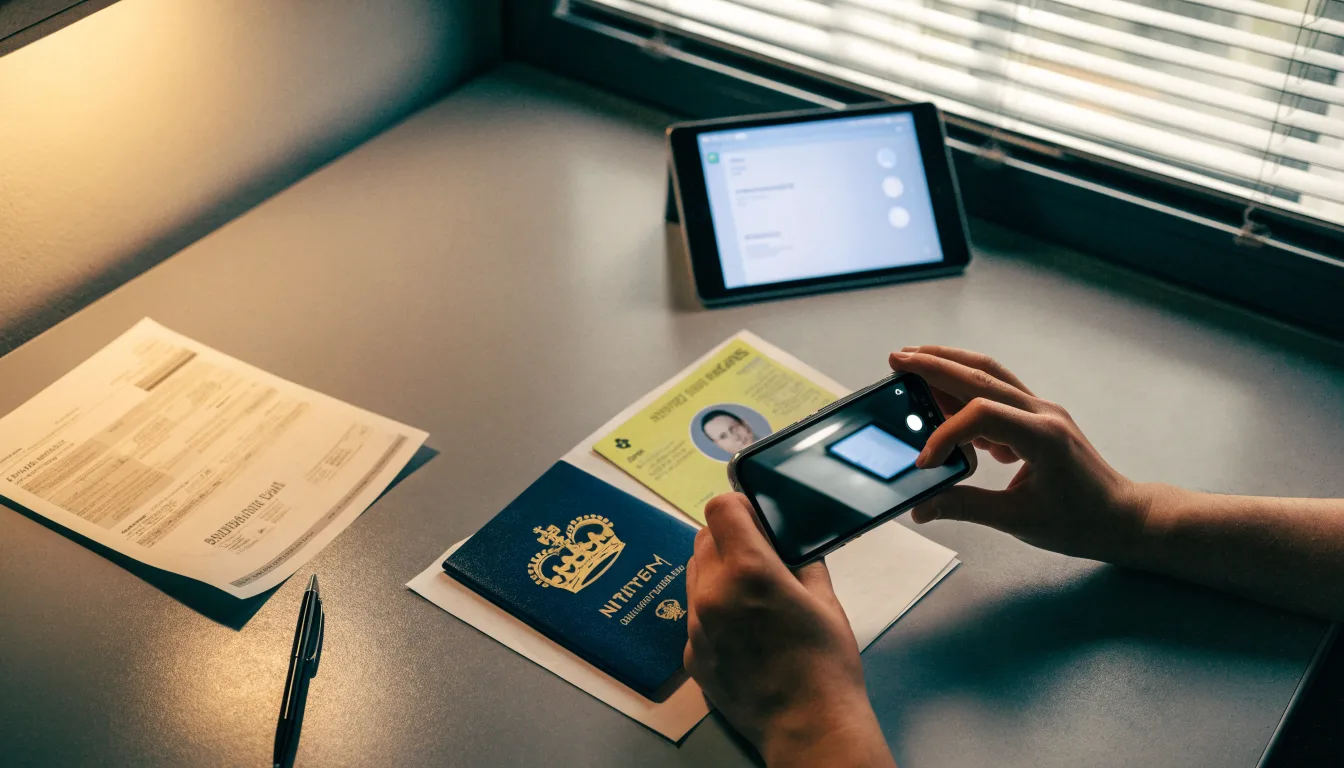
The required information includes name, address and date of birth. A casino may confirm identity electronically against databases, or ask for documents such as a passport, driving licence or household bill. The Commission does not prescribe one universal document list. A request for a selfie may arise where fraud is suspected; bank statements may be requested for source-of-funds checks.
The first check should happen before play, not as the final act of a withdrawal. Later, checks may need updating if personal details change, or if separate anti-money-laundering obligations arise. The legal threshold of €2,000 for remote casino customer due diligence is not a permission to let someone gamble unchecked until that amount: the Commission’s identity-verification licence condition requires verification before gambling. The two rules do different jobs.
Warning signs include registration with incomplete or inaccurate details, a vague demand for “any documents we choose”, and terms that say an operator can hold funds indefinitely at its sole discretion. The Commission has raised concern about “fuzzy matching” that accepts partial or equivocal identity information. A loose check at sign-up can become a hard stop at cash-out.
How the methods compare
The table compares what a customer can reasonably expect from the process, not brands. British licence rules create the strongest accountability; an offshore regulator may have its own standards, but it cannot replace British authorisation.
| Check or payout criterion | British-licensed operator | Offshore operator accepting GB play |
|---|---|---|
| Identity before gambling | Required by Licence Condition 17 | Varies by jurisdiction and operator |
| Core identity details | Name, address and date of birth | Depends on the operator’s stated rules |
| Document request | May include passport, driving licence or household bill | May include documents, but protections and recourse vary |
| Withdrawal-time identity demand | Cannot demand information that could reasonably have been requested earlier; AML duties remain | No British licence condition applies |
| Standard withdrawal deadline | No fixed maximum number of days in the LCCP | No British licence deadline applies |
| Complaints route | Internal process, then free approved ADR if unresolved after eight weeks | Depends on the foreign regulator and the operator’s terms |
A table cannot turn an offshore licence into a British one. Nor does a British licence guarantee that every complaint ends happily. It does provide a regulator, licence conditions and an approved route for unresolved disputes. The Gambling Commission is not an ombudsman and cannot itself recover money for an individual, but its records and enforcement still matter.
Five Checks to Verify Legitimate Casino Apps
1. The licence matches the operator and domain
Search the Gambling Commission’s public register rather than relying on a logo. Check that the name and website domain match the app or site being used. A licence belonging to a different company, or a seal that leads nowhere, is not evidence of authorisation.
2. Identity is explained before a deposit
Read the verification page and the terms before funding an account. The operator should say what information it may need, in what circumstances and in what form. That is not fussy paperwork; the Commission’s rules expect customers to be told before depositing what identity documents may be required.
3. Withdrawal conditions are specific
Look for the stated withdrawal methods, any processing limits and the explanation of checks. British operators cannot impose a maximum limit on withdrawals from the deposit balance, and cannot use a term giving them sole discretion to withhold winnings. “We may retain funds for any reason” is a warning, not a policy.
4. Complaints have a named route
A British licensee must provide a complaints process and access to an approved ADR provider free of charge if the dispute remains unresolved after eight weeks. The provider should be named in the terms. A vague promise to “review fairly” is not the same thing as independent adjudication.
5. The operator’s claims survive a second look
Be sceptical of guaranteed instant payouts, “no verification ever” claims and a foreign certificate presented as permission to operate in Britain. The Commission says it is illegal to offer commercial gambling services to GB consumers without its licence, including where the operator is licensed elsewhere. The easy claim is often the one least worth trusting.
A practical check before choosing an app

- Confirm the licence and domain. Use the Gambling Commission register and check the exact site or app domain. This establishes whether British rules apply.
- Read the identity policy. Find out what details and documents could be requested before depositing. This reduces the chance of an avoidable mismatch later.
- Check withdrawal and bonus terms separately. Look for time limits, fees, payment routes and any bonus conditions. British rules cap wagering requirements on bonus funds at ten times, but offshore operators are not bound by that cap.
- Check how complaints work. Find the internal procedure and, for a British licensee, the approved ADR provider. That gives a dispute a route beyond customer service.
- Use accurate account details. A full legal name, residential address and correct date of birth help identity checks match reliable records. A nickname is not a clever shortcut.
- Treat a foreign licence as limited evidence. Verify it with the issuing authority if relevant, but do not mistake it for a British Gambling Commission licence. Different regulator, different protections.
Common questions about real-money casino apps
Are there any casino apps that pay real money?
Yes. British-licensed operators offer real-money casino gambling through mobile apps or mobile websites. The relevant test is not whether the app has a cashier, but whether the operator is licensed by the Gambling Commission and the domain matches its register entry. The licence brings UK rules on identity, complaints and self-exclusion; a foreign licence does not.
Can casino apps that pay real money no deposit be trusted?
A no-deposit offer is not proof of fraud, but it is not free money in any meaningful sense. Read the wagering, expiry and withdrawal conditions before treating a displayed balance as cash. For British licensees, wagering requirements on bonus funds cannot exceed ten times from 19 January 2026. Offshore operators are not bound by that British cap.
Do free casino apps that pay real money exist?
Some apps offer free-to-play games with prizes or promotional rewards, but “free” can refer to the game rather than a withdrawable cash balance. Check whether the operator requires a deposit, whether winnings are subject to wagering, and whether cash-out is available in Great Britain. The operator’s terms and licence matter more than the word “free”.
Do casino apps that pay real money instantly exist?
A payment provider may move money quickly once an operator has approved a withdrawal, but that is not the whole journey. The Commission’s June to September 2024 data found 96.3% of withdrawals at large operators cleared automatically. That does not mean every request is instant: identity checks, anti-money-laundering duties and payment processing can take longer.
Can casino games that pay real money through Cash App pay UK players?
A payment brand does not establish that a casino is licensed to serve Great Britain. Check the operator and domain on the Gambling Commission register, then read its payment terms. The facts here do not establish that Cash App is a standard route for UK casino withdrawals, so claims promising it should be checked rather than assumed.
What is the best casino app that pays real money?
There is no responsible single “best” app on the evidence here. A more useful standard is a matching British licence, identity checks before gambling, clear withdrawal terms, and a named complaints route with access to approved ADR. App ratings and bonus size are weaker evidence; neither gives an operator permission to ignore the rules.
The app is the easy part
A credible real-money casino app is judged by the operator behind it: its licence, its early identity checks and its willingness to explain a delay. GamCare’s National Gambling Helpline is free on 0808 8020 133, 24 hours a day. The benchmark remains plain: 96.3% of 44.2 million withdrawals cleared automatically in June to September 2024 at large operators.
Casino Apps
Content created by the «Fast Payout Online Casino» team